
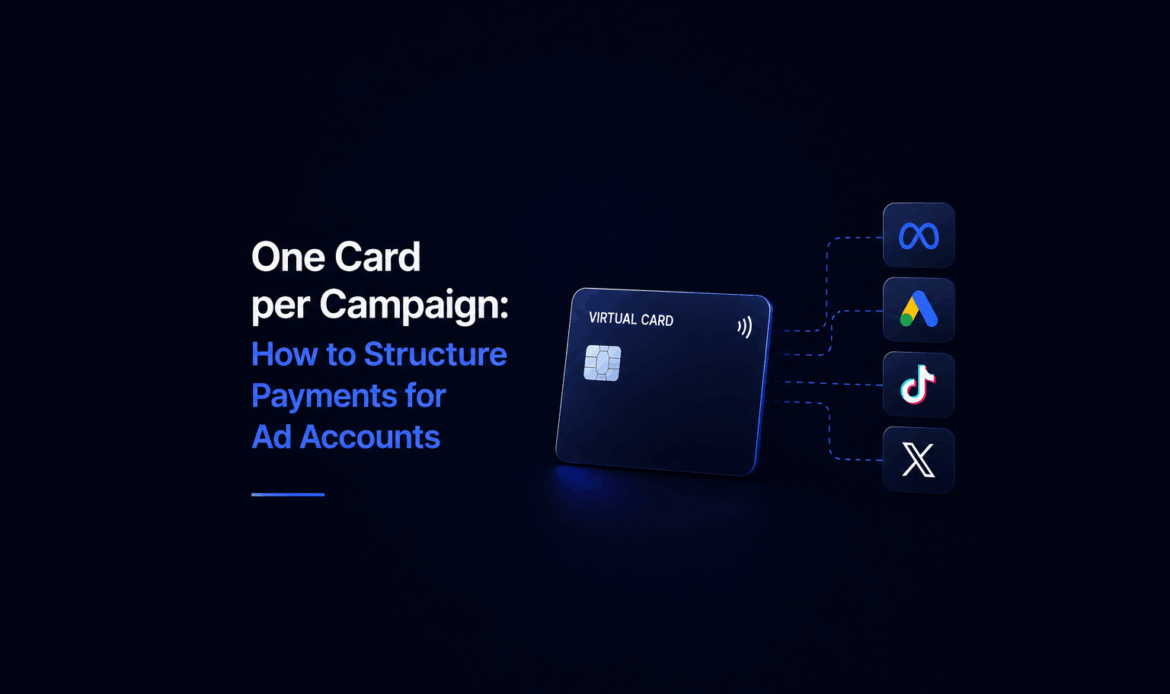
As advertising teams scale from a handful of campaigns to dozens or even hundreds, payment management quickly becomes one of the biggest operational challenges. Many advertisers start with a single payment card connected to every advertising account, only to discover that this approach creates unnecessary risks, complicated reporting, and difficult budget management.
Professional media buying teams use a different strategy: one virtual card per campaign or advertising account.
This simple payment structure makes campaign management more transparent, reduces financial risk, and gives teams complete control over advertising budgets.
In this guide, you’ll learn why experienced media buyers organize payments this way and how you can build a scalable payment infrastructure in 2026.
Why One Payment Card Isn’t Enough
Using a single payment card across multiple advertising accounts may seem convenient at first.
However, as advertising volume grows, several problems quickly appear.
- Budgets become difficult to track.
- Financial reports require manual reconciliation.
- Campaign profitability becomes harder to measure.
- Unexpected charges affect unrelated campaigns.
- One payment issue can impact your entire advertising operation.
These issues become even more noticeable when several media buyers manage campaigns simultaneously.
Why Professional Teams Use One Card per Campaign
Instead of sharing one payment method, experienced affiliate teams assign a dedicated virtual card to every campaign or advertising account.
This creates a clean financial structure where every payment belongs to one specific campaign.
Teams immediately know:
- Which campaign generated each transaction.
- How much budget has been spent.
- Which campaigns remain profitable.
- Which payment method belongs to each advertising account.
Learn more in How Affiliate Teams Track Ad Spend Across 10, 50, or 100+ Campaigns.
Better Budget Organization
Dedicated virtual cards make advertising budgets significantly easier to manage.
For example:
- Campaign A → Card A
- Campaign B → Card B
- Campaign C → Card C
Instead of sorting hundreds of transactions manually, each card already represents one budget.
This dramatically simplifies reporting for finance teams and agency managers.
Protection When an Account Is Suspended
Advertising account suspensions happen on every platform.
When multiple advertising accounts share the same payment card, a payment investigation or billing issue may affect unrelated campaigns.
Using one virtual card per account isolates financial risk.
If one advertising account is suspended, the remaining campaigns continue using their own dedicated payment methods.
This significantly improves operational resilience.
Learn more in What Happens When Your Ad Account Gets Suspended: Payment Recovery Checklist.
Faster Financial Reporting
One of the biggest advantages of payment segmentation is accounting efficiency.
Finance teams no longer need to manually identify which campaign generated each transaction.
Every virtual card already contains its own payment history.
This makes it much easier to:
- Calculate campaign costs
- Measure ROI
- Export reports
- Review advertising expenses
Better Spending Control
Each virtual card can have its own spending limits.
For example:
- Daily spending limit
- Weekly spending limit
- Monthly campaign budget
If a campaign exceeds its planned budget, only that specific card reaches its limit while the remaining campaigns continue operating normally.
Learn more in How to Set Spending Limits on Virtual Cards and Protect Your Ad Budget.
Perfect for Team Management
Growing affiliate teams often have several media buyers working simultaneously.
Assigning dedicated virtual cards allows managers to:
- Separate budgets by buyer
- Monitor spending individually
- Simplify internal reporting
- Reduce payment mistakes
This creates accountability without increasing operational complexity.
How Many Cards Should You Have?
There is no universal number.
Many successful teams follow these structures:
- One card per advertising account
- One card per campaign
- One card per client
- One card per affiliate offer
- One card per media buyer
The larger the advertising operation becomes, the more valuable payment segmentation is.
How Spending.market Makes This Easy
Spending.market was designed specifically for professional advertisers who manage multiple campaigns simultaneously.
With Spending.market, you can:
- Create up to 100 virtual cards for a single account.
- Issue new cards instantly.
- Close unused cards with one click.
- Assign separate budgets to every campaign.
- Monitor transactions in real time.
- Set flexible spending limits.
Whether you’re running ten campaigns or several hundred, Spending.market makes payment organization simple and scalable.
Learn more in Best Virtual Cards for Media Buying.
Build a Payment Structure That Scales
Using one virtual card per campaign is more than an accounting practice—it’s a scalable operating model used by successful media buying teams worldwide.
It improves financial visibility, protects budgets, simplifies reporting, and reduces operational risk when advertising accounts encounter payment or policy issues.
As your advertising business grows, organizing payments correctly becomes just as important as optimizing campaigns.
Scale Your Advertising Payments with Spending.market
Create virtual cards in seconds, organize every campaign with its own payment method, and manage advertising budgets with complete confidence.