
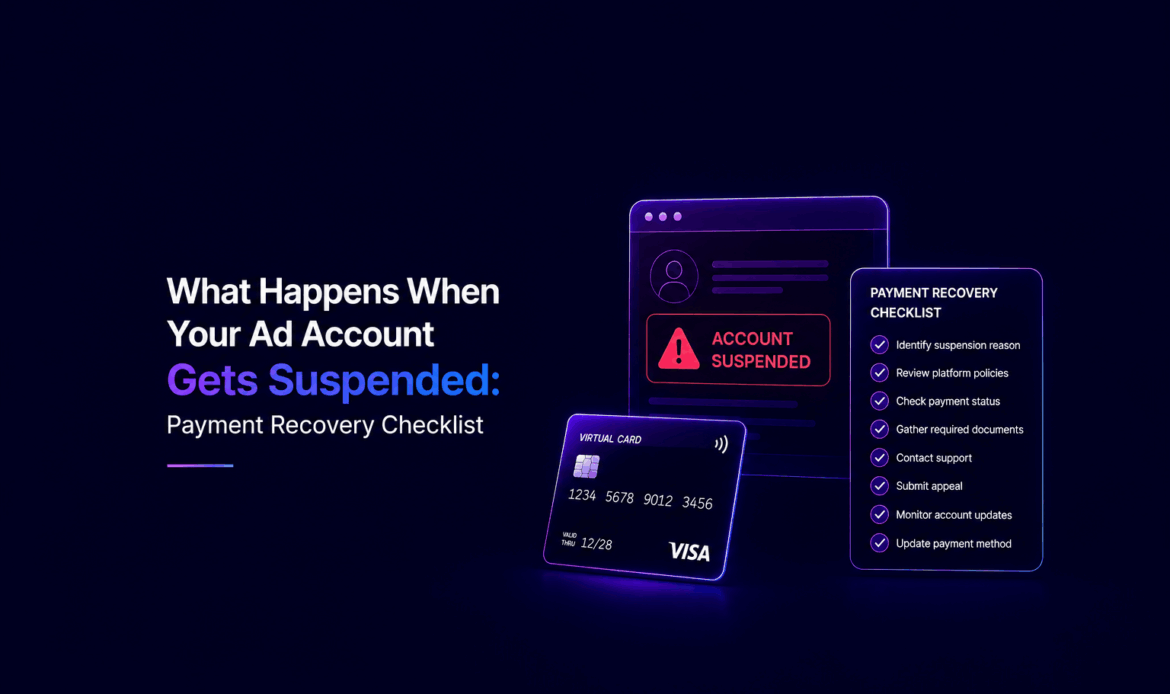
Having an advertising account suspended is one of the most stressful situations for media buyers, affiliate marketers, and agencies. Campaigns stop immediately, traffic disappears, and questions quickly arise about budgets, payment methods, pending charges, and financial recovery.
While account suspensions are never ideal, reacting quickly and following a structured recovery process can help minimize financial losses and get your advertising operations back on track.
In this guide, we’ll walk through a practical payment recovery checklist for 2026, covering what to do with your virtual cards, advertising budgets, pending transactions, and payment infrastructure after an account suspension.
Step 1: Don’t Panic — Verify the Suspension
Not every interruption means a permanent suspension.
Advertising platforms may temporarily restrict an account due to:
- Identity verification
- Billing reviews
- Policy compliance checks
- Security alerts
- Unusual account activity
Before making changes, carefully review the notification inside the advertising platform and determine whether the restriction is temporary or permanent.
Step 2: Check Your Payment Status
The next priority is understanding your financial position.
Review:
- Pending payments
- Outstanding balances
- Recent successful transactions
- Declined payments
- Automatic billing schedules
This helps determine whether additional charges may still be processed after the account has been suspended.
Step 3: Review Your Virtual Card Activity
If you’re using virtual cards, check the transaction history for the affected advertising account.
Look for:
- Pending authorizations
- Recent charges
- Duplicate payments
- Unexpected billing activity
Real-time transaction monitoring makes it easier to identify whether additional payments are still being processed.
Learn more in How to Set Spending Limits on Virtual Cards and Protect Your Ad Budget.
Step 4: Freeze or Pause the Card if Necessary
If the advertising account will no longer be used, temporarily freezing the associated virtual card can prevent unexpected future charges.
Many virtual card platforms allow users to:
- Freeze cards instantly
- Adjust spending limits
- Block future payments
- Replace cards if needed
This adds an extra layer of financial protection while you assess the situation.
Step 5: Separate Active Campaign Budgets
If your team manages multiple advertising accounts, avoid allowing one suspension to impact unrelated campaigns.
Using dedicated virtual cards for each advertising account helps isolate budgets and reduces operational risk.
This is one reason experienced media buying teams rarely use a single payment card across multiple accounts.
Learn more in How to Manage Multiple Ad Accounts with One Payment System.
Step 6: Check for Unsettled Charges
Some advertising platforms process charges after campaigns stop running.
Before closing cards or moving budgets, verify whether there are:
- Pending settlements
- Outstanding invoices
- Delayed billing cycles
- Final campaign charges
Waiting for all legitimate charges to settle helps avoid unnecessary payment disputes.
Step 7: Document Everything
Maintain detailed records of:
- Suspension notifications
- Payment confirmations
- Invoices
- Transaction history
- Support conversations
This information may be useful if you need to appeal the suspension or resolve billing questions later.
Step 8: Review Your Internal Payment Structure
A suspension often reveals weaknesses in payment organization.
Ask yourself:
- Was one card used across multiple accounts?
- Were spending limits configured?
- Could budgets have been isolated better?
- Was reporting detailed enough?
Improving payment structure today reduces operational risk tomorrow.
Common Mistakes After an Account Suspension
Many advertisers react too quickly and create additional problems.
Avoid:
- Closing cards before payments settle
- Ignoring pending transactions
- Mixing budgets across accounts
- Deleting financial records
- Changing multiple payment settings simultaneously
A structured recovery process usually leads to better long-term outcomes.
How Virtual Cards Improve Recovery
Virtual cards make payment recovery significantly easier because each advertising account can have its own dedicated payment method.
This allows teams to:
- Freeze individual cards
- Protect unrelated campaigns
- Track outstanding charges
- Control remaining budgets
- Maintain clear financial records
Learn more in Virtual Cards vs. Agency Ad Accounts: Which Is Better for Scaling?.
How Spending.market Helps During Account Recovery
Spending.market provides payment infrastructure designed specifically for media buyers, affiliate marketers, and advertising agencies.
With Spending.market, users can:
- Issue virtual cards instantly
- Freeze cards immediately
- Set spending limits
- Track transactions in real time
- Manage budgets across multiple advertising accounts
- Protect advertising funds during unexpected disruptions
The platform supports Facebook Ads, Google Ads, TikTok Ads, X Ads, and other major advertising channels.
Learn more in Best Virtual Cards for Media Buying.
Payment Recovery Starts with Better Preparation
Account suspensions cannot always be avoided, but financial losses can often be minimized.
A structured payment system, dedicated virtual cards, clear budget separation, and real-time transaction monitoring help advertisers recover faster while protecting the rest of their advertising operations.
Preparation is often the biggest difference between a temporary setback and a major financial disruption.
Protect Your Advertising Budgets Before Problems Happen
Manage advertising payments, control virtual cards, and build a payment infrastructure that keeps your campaigns protected with Spending.market.