
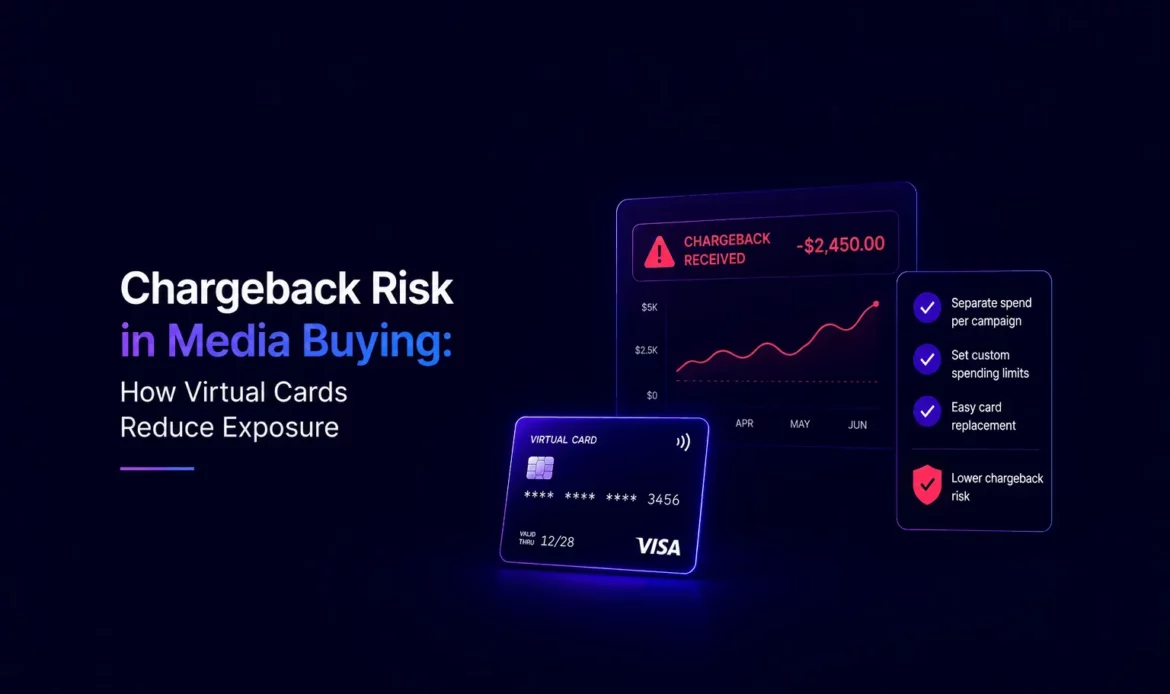
Chargeback risk in media buying is usually discussed as if it were one thing, but a team meets it from two sides. On one side are disputes on the card that pays for ads — a charge the team does not recognise, a stolen card, a buyer who disputes a payment by mistake. On the other side are chargebacks from end customers of the offer, which affect payouts from the network. Virtual cards help with the first and do almost nothing for the second.
Let’s be honest from the start: no card removes chargebacks. What the right payment structure does is reduce the number of situations that end in a dispute and limit the damage when one happens. Below is where the risk comes from, what it costs and what to change in your setup.
Contents
- What a Chargeback Is
- Where Chargeback Risk in Media Buying Comes From
- Why Disputing an Ad Charge Usually Backfires
- How Virtual Cards Reduce Chargeback Risk in Media Buying
- What Virtual Cards Do Not Fix
- What Separation Costs Compared With One Bad Dispute
- A Short Routine That Keeps Disputes Away
- Summary
What a Chargeback Is
A chargeback is a reversal of a card payment initiated through the cardholder’s issuer after a dispute. It was designed to protect cardholders from unauthorised or incorrect charges. For the merchant, in this case the ad platform, a chargeback means the money is taken back and the payment is treated as a risk signal.
Where Chargeback Risk in Media Buying Comes From
| Source | What happens | Can a virtual card help? |
|---|---|---|
| Unrecognised charge | Finance sees a charge it cannot match to an account and disputes it | Yes: a card per account makes every charge traceable |
| Compromised card | Card details leak and someone else spends from them | Yes: the card is closed instantly, before more charges arrive |
| Dead account still charging | An abandoned account bills its last spend, and someone disputes it | Partly: plan the final charge, then close the card |
| Disputing a legitimate ad charge | The team disputes a payment for ads that ran | No: the platform sees it as a risk signal regardless of the card |
| Chargebacks on the offer side | End customers dispute purchases; the network deducts them from payouts | No: this is the offer’s risk, not the ad payment’s |
Why Disputing an Ad Charge Usually Backfires
When a platform receives a chargeback on an ad payment, it has delivered the impressions and lost the money. The typical reaction is to restrict the ad account, and often the profile or business account linked to it, and to treat the unpaid amount as debt. The account may also stop accepting new payment methods.
That is why a chargeback is the last tool, not the first. If a charge looks wrong, check the billing history in the ad account, contact the platform’s support and only then decide. In most cases the “unknown” charge turns out to be a threshold payment from an account someone forgot about. How payment problems lead to restrictions is covered in How to Avoid Ad Account Bans Due to Payment Issues.
How Virtual Cards Reduce Chargeback Risk in Media Buying
Every charge has an owner
With one card per ad account, each line in the transaction history belongs to one account and one buyer. Finance does not need to dispute anything to find out what a charge was. This is the main reason teams move away from a shared card; the structure is described in One Card per Campaign: How to Structure Payments for Ad Accounts.
A leaked card is closed, not disputed
If card details are exposed, you close the card in one click in the dashboard, and closing is instant. New charges have nowhere to land, and you issue a replacement in about 60 seconds. The dashboard is protected with 2FA, and every transaction is monitored.
Fewer failed charges, fewer messy retries
Repeated declines and retries are a source of confusion in billing history: the same amount appears several times with different statuses. Our pass rate on Facebook Ads, Instagram Ads, Google Ads, TikTok Ads and X Ads is 97–99%, so out of 100 charges one to three may need a retry. A clean history is easier to reconcile and less likely to provoke a mistaken dispute.
What Virtual Cards Do Not Fix
- They do not cancel debt to a platform: a closed card does not erase the amount the account owes.
- They do not protect an account that was restricted for its ads, landing pages or offers.
- They do not reduce chargebacks from the offer’s customers; that depends on the offer, the traffic quality and the network’s terms.
- They do not replace a reconciliation routine: someone still has to compare charges with spend.
What Separation Costs Compared With One Bad Dispute
Take a team with 15 ad accounts on the Base plan, one card each: issuance 15 × €1.5 = €22.5 once, maintenance 15 × €1.5 = €22.5 a month. On Mid the figures are the same, and on VIP it is 15 × €1.0 = €15 for issuance and €15 a month for maintenance. The top-up commission (3.5%, 2.5% or 1.7%) is paid on the money you put in, whether you use one card or fifteen.
Against that, one disputed €2,000 threshold charge can turn into a restricted account, an unpaid debt and a lost campaign setup. The extra €22.5 a month for structure is small next to that.
A Short Routine That Keeps Disputes Away
- One card per ad account; never share a card between accounts or buyers.
- Weekly: compare the transaction history with spend in each ad account. How teams do this at scale is in How Affiliate Teams Track Ad Spend Across 10, 50, or 100+ Campaigns.
- Before abandoning an account, let it bill its final amount, then close the card.
- If a charge looks unfamiliar, investigate in the ad account first and dispute only after support has been contacted.
- If an account has already been restricted, follow the steps in What Happens When Your Ad Account Gets Suspended: Payment Recovery Checklist.
Summary
Chargeback risk in media buying comes mostly from confusion and leaks, not from the platforms. Virtual cards address exactly that: every charge is traceable, a leaked card is closed instantly, and a cleaner history means fewer mistaken disputes. They do not cancel debt or offer-side chargebacks, and nobody should promise otherwise. Cards for each platform are on our Facebook Ads, Google Ads and TikTok Ads pages.